Week II • Monday
Uganda
Week II • Monday
Voices from the Landscape
Working in leadership has exposed me to some of the contrasts of this nation, Uganda. I move between the prosperous central region to the north still held back in terms of development; between those in authority in the centre: glossy skinned and well fed; and the lean, weather worn people of the northern region; between those with the power to impose unreasonable expectations on those in poverty and those struggling to lift themselves beyond the poverty mindset.
I remember that Jesus was a northerner, from Galilee with a distinctive accent and clothing. He entered Jerusalem and came face to face with the controlling powers: Temple leaders, Roman rulers, and the spiritual powers that abound in such contrasts and places of injustice.
In confronting the principalities and powers Jesus, in Jerusalem, found himself caught up and embroiled in local and religious politics.
His penance was trial, flogging and crucifixion. There was no reconciliation between the broken religious system of the Temple and the radical message of the cross. Those in power were wedded to position and influence.
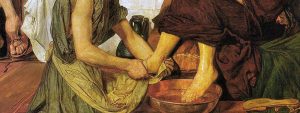
The love of God took the humble way of sacrifice and service, but the confrontation was not avoided.
From a College Principal.
wonderings
- I wonder what it means to follow Jesus in places where power and wealth overshadow justice and compassion.
- I wonder how Christ might be inviting me to see the humanity behind systems that harm – both the humanity of the oppressed and the humanity buried within the powerful.
- I wonder where I am called to speak truth with courage, and where I am called to love with tenderness, even when the two feel hard to hold together.
Reflection
Hearing this principal describe the stark contrasts between wealth and poverty, power and powerlessness, brings to mind the work of South African theologian Allan Boesak. Boesak insists that Christian faith cannot be separated from the social and political realities in which people live. For him, the Gospel always asks: Who benefits? Who suffers? Who is silenced? Who is seen? In societies marked by vast inequality – where a glossy-skinned elite coexists with weather-worn communities – this question is not optional. It is the heart of discipleship.
Boesak argues that Jesus is not neutral in the face of oppression. Jesus stands with those pushed to the margins, speaking truth to the systems that create and sustain inequality. And yet, Jesus does not dehumanise those in power. He confronts them – as when he entered Jerusalem – but does so to reveal their lost humanity, calling even the powerful back into the justice and mercy of God.
In the principal’s reflection, we glimpse this tension: the unavoidable encounter with entrenched structures, and the call to resist them without losing compassion. Living in a society driven by wealth accumulation, where influence is often prized over integrity, we are invited to follow Christ’s way – a path neither submissive nor violent, but grounded in truth-telling, courage, and radical love.
Boesak teaches that following Christ means recognising that liberation is not merely spiritual but social; not only personal but communal. In the face of unjust systems, the disciple’s task is to hold fast to the humanity of all – confronting wrongdoing while refusing to abandon the hope that even power can be redeemed.
prayer
God of justice and gentleness,
this Lent we lift before you
all who hold authority –
from parish councils
to prime ministers,
from presidents to army generals.
Turn their hearts toward mercy,
wisdom, and the common good.
Holy One, shelter the vulnerable,
strengthen those who work for peace,
and soften the hearts of those
who seek power at any cost.
Let your justice take root
like rain on dry ground,
and your compassion rise
like healing light over the land.
bible reading
John 1:1–18
In the beginning was the Word
John begins his Gospel with words that sound like music: “In the beginning was the Word… and the Word became flesh and lived among us.” David Ford, a theologian, calls this opening a kind of overture – a beautiful introduction that hints at everything the Gospel will explore. John is not simply setting out ideas about God; he is telling a story of movement, of love stepping toward us. The Word who has always been with God does not stay distant. Instead, God crosses every boundary and comes into the real world of skin and bone, laughter and fear, culture and conflict. This is the heart of the Incarnation: God chooses to live right in the middle of the human story.
Emmanuel Lartey, a writer from the African continent , helps us see just how practical this really is. In his writing on intercultural life and ministry, he says that when God’s Word becomes flesh, it becomes flesh in every culture, every community, every place where people live their daily lives. God speaks through many voices, many traditions, many ways of seeing the world. That means difference is not something to
be afraid of; it is where God is already at work. Lartey talks about the courage to cross into unfamiliar spaces – to meet people whose stories stretch us, whose backgrounds challenge ours, whose experience of the world is different from our own. These crossings, he says, are where light breaks in. Something new is revealed when we risk genuine encounter. In that moment, we discover that the Word did not come to erase difference but to inhabit it – to show us that God’s presence shines through every shade of human life.
This is where the Franciscan tradition comes alive. For Franciscans, “penance” does not mean feeling bad about ourselves. It means turning again toward God’s way of love — and that always involves turning outward toward other people. It means learning to see Christ in those who are not like us. When Francis crossed the desert to meet the Sultan, he was living the Prologue with his feet. He didn’t go to win a battle of ideas. He went to meet another human being face to face, trusting that God was already present in that encounter. Francis crossed a boundary, and in doing so he found peace, respect, and a deeper sense of God’s wide, generous love. His journey shows us that God’s movement into the world invites our movement toward one another.
When we put the ideas of Ford and Lartey together, the Prologue becomes even more vivid. It is not just the story of what God did two thousand years ago; it is a pattern for how we are meant to live today. God still takes flesh whenever people cross barriers, listen to each other, and recognise the divine image in unfamiliar places. The Word becomes flesh again whenever we practise what might be called “intercultural grace” – the openness to learn from others, the humility to be changed by a conversation, the willingness to see God’s light in faces we do not yet understand.
To live the Prologue now is to keep crossing boundaries, keep widening our circles, and keep trusting that the God who moved toward us in Jesus is still moving among us – in every culture, every community, and every courageous act of love.

reflective action
Choose one small action that resists the pull of privilege or self-protection: listen deeply to someone whose life feels far from your own or advocate for someone overlooked, or practise generosity that costs you something.
Let this be your quiet act of standing with Christ among the marginalised – and of calling power back to humanity.
journalling prompt
In Africa they say, when elephants fight, it is the grass that suffers – think about the ordinary people who bear the weight of brutality, famine, disease, lost education and fragile health care.
Imagine Jesus walking with you through the contrasts described by the principal — from the prosperous centre to the weather-worn north, from offices of influence to villages of struggle.
What does power and justice look like in this place or in your landscape . Let an image, a phrase, a colour, or a story emerge on the page as you write or sketch what you see.