Week IV • Friday
Voices from Gaza and West Bank
Week IV • Friday
Voices from the Landscape
“The Israelis say the land belongs to us,
we Palestinians say we belong to the land”
Abu Assam
farmer in West Bank village of Jayous
“You want to prove that the bible is right?
You don’t do it by pointing to self-fulfilling prophecy or by pointing to world events as prophecy fulfilment.
We prove that the bible is right by radical obedience to the teachings of Jesus.
Let us love our enemies, forgive those who sin against us.
Let us feed the poor
Care for the oppressed.
Be inclusive not exclusive.
Turn the other cheek.
And maybe then, the world will start to take us seriously
and believe our bible.
Rev’d Munther Isaac
Lutheran Pastor in Ramallah
wonderings
- I wonder what it means to “belong to the land” rather than to possess it.
- I wonder where I see radical obedience to Jesus — love for enemies, care for the oppressed — in my own community.
- I wonder what truths about history, complicity, or silence I resist naming.
- I wonder what repentance might look like not only for nations, but for me personally in this season of Lent.
Reflection
I prefer not to talk about the’ Israeli Palestinian Conflict’ rather to see the ongoing suffering in the region as a result of colonialism. We in Britain are of course part of this having been responsible for the British Mandate in Palestine and leaving with undue haste in 1948, which led to the forced displacement of 700,000 Palestinians. British Colonialism and settlement is a pattern that is being repeated by Israeli Settlers today forcing Palestinians off their land in the West Bank.I was there in March 2024.
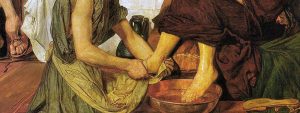
On Maundy Thursday which that year was in Ramadan, rather than going to Church I went to the Palestinian village of Um Al Khair, which receives daily intimidation from Israeli Settlers armed with automatic weapons. Settlers had moved sheep financed by the Israeli government onto the villagers land. The villagers were keeping their sheep their only source of income, in a cave and feeding them expensive fodder. Instead of foot washing we shared an Iftar meal breaking the fast of Ramadan as the sun went down. We shared it not only with the villagers, but with a group of South African Muslims and a number of Israeli peace activists who were providing protection by presence.
Peace will only come when those in power in America the UK and Europe repent of their complicity in the breaches of International Law by Israel which have been going on since 1948 and their complicity in what many including the United Nations and reputable Jewish Holocaust scholars are naming as the Genocide in Gaza. Most Church leaders have been woefully reluctant to do this, but it’s never too late to repent.
Jonathan Herbert
prayer
God of justice and mercy,
open our eyes to the truth
of suffering and our part in it.
Root us in compassion,
steady us in courage,
and teach us the costly love that heals wounds and restores dignity.
Let your peace grow in us,
and through us,
for all who long for freedom.
bible reading
John 9:35–41:
Seeing in the Ruins: The Light of the Olive Tree
When Jesus finds the man who had been blind and asks, “Do you believe in the Son of Man?”, the story turns decisively from sight to recognition. What began as physical healing opens into spiritual awakening. The man who once sat in darkness now stands not only in daylight, but in the radiance of relationship. “Lord, I believe.” Faith here is not an idea embraced but an encounter received. Light is no longer abstract or distant; it is personal. Seeing happens because two gazes meet – human vulnerability and divine presence.
This movement lies at the heart of John’s Gospel. Truth is not something to be mastered but someone to be met. The healed man’s confession is not the conclusion of an argument but the fruit of being addressed. He sees because he has first been seen – recognised, sought out, and named by Jesus after being cast out by others. His faith is born not of certainty but of vulnerability. Encounter, not control, is what opens his eyes.
Read through the witness of Palestinian theology, especially amid the devastation of Gaza, this story unfolds again in the dust and rubble of our own world. True blindness today is not the absence of vision but the refusal to perceive the sacred in suffering. It is the failure to recognise God’s image in those whose homes are shattered, whose olive trees are uprooted, whose cries are drowned out by politics, fear, and noise. Lent calls this blindness by its proper name: sin – not as moral failure alone, but as a turning away from relationship.
Around the blind man’s awakening, however, lingers the shadow of refusal to see by other people – the religious authorities. Those who claim to see- the guardians of religious order and certainty- remain blind to the God standing before them. They protect coherence and religious tradition at the expense of compassion, purity at the cost of relationship.
However, Jesus’ words to these people , “Your sin remains,” are not spoken in anger but in grief. They name the tragedy that arrogance can make us blind even in full daylight, resistant to the interruption of grace.
Here penance becomes more than personal remorse. It is the willingness to be interrupted, to let our settled certainties be unsettled by suffering love. Peace, in this Gospel, is not the absence of conflict but the restoration of relationship. Reconciliation begins where we allow ourselves to be addressed by Christ in the wounded other.
So the Gospel of John becomes not only a text of revelation but a landscape of resistance and hope. In Gaza’s ruined streets, in Bethlehem’s watchful stillness, the light of Christ does not shine from above but rises from within the wounded earth itself. Like the olive tree that sends green shoots from scorched soil, divine light persists- fragile yet unquenchable, rooted in place, relationship, and love.
The man born blind, standing before Christ, mirrors the faith of those who still look for light in the long night of siege. He does not demand explanation or ideology; he simply opens his heart to encounter. His awakening mirrors the steadfastness (sumūd) described by Palestinian theologians—that patient endurance which refuses despair, that quiet faith which plants again among the ruins.
In this context, sight becomes solidarity. To see truly is to stand with those who suffer; to recognise in their faces the living Christ. It means allowing the world’s pain to pierce our own guarded eyes until we perceive the light that bleeds through the cracks of history. The cross and the olive tree interpret each other here: the cross as the sign of divine solidarity in human suffering, the olive tree as the promise of resurrection life rooted deep in the wounded land.
For those who walk the way of Francis, this passage calls us to the same humility as the healed man—to confess our blindness, to kneel before the suffering Christ who dwells in the broken body of the world. To see rightly is to see as God sees: to recognise the sacred in the rubble, the light flickering in Gaza’s night, the olive shoot springing from the stump.
True sight, then, is not to escape the darkness but to stand within it with open eyes. It is to believe that even in devastation, God’s wounded love still works its quiet miracle of seeing, healing, and hope.

reflective action
Go to the website of the Israeli Committee against Hse Demolitions.
Buy Palestinian fairly traded Zaytoun Olive oil.
journalling prompt
Where do I feel called to stand in solidarity – to place myself, even quietly, on the side of dignity, truth, and protection?
What fears, habits, or loyalties might keep me from that stance?