Holy Week • Good Friday
Antarctica
Holy Week • Good Friday
Voices from the Landscape
The wounds of Antarctic
Antarctica is a land of immense silence—a silence so total it presses against the heart. Its beauty is stark, crystalline, otherworldly. Yet those who know this continent speak as much about its wounds as its wonder.
The wounds appear first as small shifts: a glacier that once moved slowly now rushes towards the sea; a shelf that held firm for millennia cracks with a sound like thunder; a colony of penguins returns to find the ice melted beneath their feet. A continent built of ice is learning what it means to melt.
The temperatures rise. Storms become more violent. Ancient ice sheets, deep as cathedrals, shed their edges into the ocean. Meltwater pools where only frozen ridges once stood. Scientists describe this change with words tinged by grief : “collapse”, “fracture”, “irreversible loss”.
And yet, there is still beauty. The dawn paints the ice in colours no artist could mix. The wind shapes snow into delicate sculptures. The aurora dances across the winter sky like a silent hymn. But every beauty now carries a bruise: a reminder that this land, so remote and so vast, is wounded by the choices of the world far to the north.
The hurt of Antarctica is not only environmental; it is moral. It stands as a witness to the cost of human consumption, the weight of global choices, and the fragility of the Earth’s coldest sanctuary. Its silence has become a cry—not in anger, but in warning and lament.
Antarctica is a wounded beauty, holding both splendour and sorrow. It invites us to look honestly at what is breaking, and to listen to a landscape whose quiet voice speaks truth about our common home.
wonderings
- I wonder how the stark, wounded beauty of Antarctica helps me see the cross as God’s solidarity with a hurting world.
- I wonder where I see “water and blood”, the costly flow of love, in my own life, my community, or the earth today.
- I wonder what parts of my life feel like a vast and frozen landscape, and how Christ might already be standing with me there.
- I wonder what new life might be quietly forming beneath the surface of this Good Friday silence.
Reflection
Good Friday leads us to the places where life is stripped back to truth. John 19:1–37 is a passage of exposure: Christ exposed to violence, humanity exposed in its cruelty, and God exposed in a love that will not withdraw. The Antarctic, vast, raw, wounded,becomes an unexpected companion to this day.
Like the cross, Antarctica reveals both suffering and presence. Its fractured shelves and melting glaciers mirror the body of Christ, broken open by the violence of empire. The continent’s vulnerability bears silent witness to creation’s own crucifixion—the groaning of the earth beneath the weight of human choices.
And yet, the cross is not simply the site of suffering; it is the place where God chooses to be with. Sam Wells reminds us that God’s deepest action is presence: not fixing, not controlling, but being with us in the realities we cannot escape. On Good Friday, Christ is with every wounded body, every vulnerable community, and every damaged ecosystem. In the starkness of Antarctica, God’s solidarity stretches all the way into creation’s pain.
Jürgen Moltmann goes further: in the crucified Christ, God enters suffering from the inside. There is no wound, human or planetary, in which God is absent. The cross shows us that God’s love does not shy away from the world’s fractures, but chooses to dwell within them. The water and blood that flow from Jesus’ side become signs of life emerging from brokenness, the costly outpouring of love for all that God has made.
This is why Good Friday is a moment of revelation: not that God demands suffering, but that God refuses to abandon a suffering world. The wounded Antarctic and the crucified Christ both stand as testimony that beauty and pain can coexist—and that God’s presence is found precisely where the world is hurting.
Together they whisper a truth we need: God has not given up on humanity. God has not given up on creation. And even in the wounds, of ice, of earth, of body, love is still flowing.
prayer
Crucified Christ,
be with all who stand in places of pain—
with the wounded earth,
with the wounded world,
with the wounded parts of us.
Stay with us in the darkness,
until your love is all that remains.
bible reading
GOOD FRIDAY
John 19:1–38
Good Friday takes us into the starkest places—not only in Scripture, but in the world, and in ourselves. John 19 leads us out onto the ice. It is the holy place where humanity’s cruelty meets God’s unrelenting love. The Antarctic, with its vast white silence and almost unbearable exposure, becomes an unexpected teacher for this day. In that landscape everything is stripped back. There is no noise, no shelter, nothing to hide behind. Only light, ice, wind, and truth. On Good Friday, Christ is exposed like that. Humanity’s violence is exposed like that. And God’s love shines with a clarity almost too bright to bear.
Jesus stands before Pilate, bruised by the blows the Roman empire uses to keep itself intact. The soldiers mock him with a robe and a crown. In John’s account, Jesus remains astonishingly composed. He is wounded but not diminished, humiliated yet still truthful. It is an extraordinary paradox: Jesus refuses retaliation, yet he also refuses collapse. He stands in the full force of human cruelty and remains present. Sam Wells’ theology of “being with” becomes powerful here—
God’s deepest work is not controlling, fixing, or rescuing, but being with, dwelling alongside us in the very places where life fractures.
Good Friday is the supreme moment of God “being with.” Christ does not evade the world’s violence; he inhabits it. He is with the tortured, the humiliated, the abandoned, the scapegoated. And he is with the earth itself—with lands torn open, waters polluted, species vanishing into extinction. Antarctica knows something about this. Its melting glaciers, cracking shelves, and destabilised ecosystems bear silent witness to a planet under pressure. Creation, too, is crucified. On the cross, Christ is in solidarity not only with humanity’s suffering but with the suffering of the earth.
John describes Jesus being “lifted up.” In this lifting, the brutal instrument of execution becomes a place of revelation—not because God demands blood, but because human violence is exposed and God refuses to answer violence with more violence. Jürgen Moltmann insists that on the cross God is not distant, not watching from safety. God is present in the suffering. The cry of the crucified is taken into the very life of God.
At the centre of this passage is the detail John lingers over: the water and blood flowing from Jesus’ pierced side. These are signs—of birth, cleansing, sacrament, new creation. They are also signs of a world wounded: rising seas, melting ice, polluted rivers, species unable to speak their suffering. In the water and blood of Christ we see God’s love poured out for a creation that groans for healing. Yet even here life moves: even in death something begins that will unfold in resurrection. Love cannot be stopped by cruelty. It cannot be extinguished by death. Antarctica, so cold and desolate, still hides seeds of life in deep ocean currents, in microbes beneath the ice, in creatures adapted to extremes. Life waits in the starkest places.
John also shows us the small human acts surrounding the cross: the women who stand close, the beloved disciple who remains, the moment Mary is given a new son and the disciple a new mother. Community forms in the place of pain. This is what “being with” looks like—remaining, not leaving; honouring the broken; refusing to let death have the last word in dignity.
Good Friday does not invite us to explain suffering but to stand with Christ who stands with all who suffer. The cross is not the glorification of pain. It is the place where God says, “I am here. I will not leave you. Not in your wounds, not in your loneliness, not in your fear, not in your death.” In the icy wilderness, explorers speak of a strange truth: in the most desolate places, companionship becomes everything. Presence is life. Good Friday reveals the God who chooses presence over power, solidarity over safety, love over fear.
And so the cross becomes the world’s turning point—not because it ends suffering, but because it declares that suffering will never be a place where God is absent. In the water and blood, new life begins to move beneath the surface. God does not give up on humanity. God does not give up on the earth. God stays—all the way through death—until love has the final, unbreakable word.
reflective action
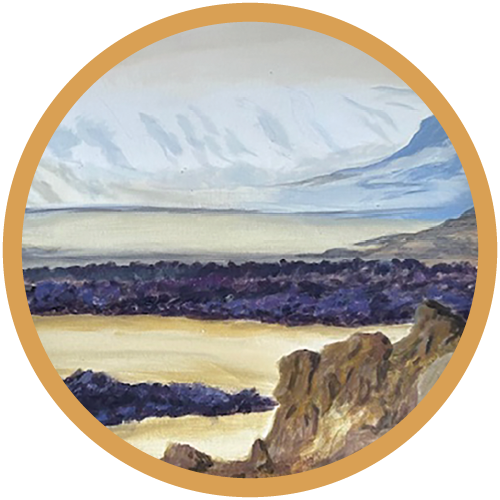
Sit in silence Imagine ( or look at images of ) the stark Antarctic landscape—exposed, wounded, truthful.
Hold before God one place in the world, or in your own life, that feels fragile.Whisper quietly:
“Christ, be with me in this place.”
Let the silence be your act of solidarity with all who suffer.
journalling prompt
Create a page about a place in your life or in the world that feels exposed, fragile, or abandoned —a kind of inner Antarctica.
How might Good Friday invite you to imagine Christ being with you (and creation) in that very place, offering presence, dignity, and the slow movement of hidden life.