Week III • Monday
Guatemala
Week III • Monday
Voices from the Landscape
Guatemala is a land of stunning beauty and deep sorrow. Its dramatic geography -volcanoes rising like ancient sentinels, highland lakes shimmering in morning mist, dense Petén jungles hiding the stones of great Mayan cities -holds within it the memory of a people who have endured centuries of violence, resilience, and quiet, stubborn hope.
Here, more than half the population identifies as Indigenous: Maya K’iche’, Q’eqchi’, Mam, Kakchiquel, and many others. Their languages, textiles, rituals, and stories form a tapestry older than the nation itself. And yet this same Indigenous majority suffered some of the worst atrocities in Latin American history. During the civil war (1960–1996), more than 200,000 people were killed — over 80% of them Indigenous. Entire villages were erased in what truth commissions later named for what it was: genocide.
The land remembers. The mountains once sheltered families fleeing soldiers. The rivers carried both refugees and the bodies of the murdered. The ceiba trees -sacred in Maya cosmology -stood silently as homes burned.
Today, Guatemala is a country where truth-telling is still a fragile act. Survivors continue to carry testimonies in their bodies and their weaving. Murals bloom on public walls, names of the disappeared are spoken in community rituals, and Maya spiritual guides hold ceremonies that braid together memory and healing.
In remote highland villages, elders speak of the “time of great silence,” when grief could not be voiced for fear of death. Yet now, slowly, truth is rising like dawn. The REMHI and CEH reports, the trials of war criminals, and the perseverance of the abuelas (grandmothers) who refuse to forget – all have become sacred forms of resistance.
For Guatemala, truth is not a political strategy but an act of survival. It is a way of honouring the dead and protecting the living. Here, truth becomes prayer, penance, and peace – the courage to remember so that the land may heal.
wonderings
- I wonder how truth can be both painful and healing at the same time.
- I wonder what stories in my community still wait for the safety to be spoken aloud.
- I wonder where I have seen courage like that of the abuelas- the quiet, persistent courage that refuses to forget.
- I wonder how God’s presence is revealed among “the crucified peoples” of today, and what it asks of me.
Reflection
Healing the Land Through Truth
Guatemala’s landscape holds both splendour and sorrow. Volcanoes, jungles, and sacred ceiba trees rise like witnesses to a story too heavy for words. The land itself has become a carrier of trauma, memory, and prayer. Latin American theologian Jon Sobrino often says that “the crucified peoples of history” are the place where God is most clearly revealed. Nowhere is this truer than in Guatemala, where the wounds of genocide still pulse beneath the soil.
During the years of violence, truth became dangerous. To speak of the dead was to risk becoming one of them. Yet the Maya elders say that truth, like dawn light over Lake Atitlán, cannot be held back forever. It rises slowly but faithfully. In this way, truth itself becomes a sacrament: a visible sign of the hidden work of God.
Latin American theologian Elsa Tamez writes that God’s justice is not about vengeance but about restoring life to those who have been diminished. In Guatemala, truth-telling functions precisely in this way. The testimonies gathered in the REMHI and CEH reports, the courage of Indigenous women who testified about sexual violence, and the perseverance of the abuelas searching for their disappeared children act as forms of resurrection. They insist that those whom the state declared “erased” are still present, still beloved, still bearing dignity.
Maya theologians speak of utzilal, the harmony of a community living in truth. Harmony can never be built on forgetting. Healing begins when the people face what happened with honesty and ritual, weaving memory back into the life of the community. Maya spiritual guides describe truth-telling as a ceremony: lighting copal incense, naming the dead, asking the ancestors to accompany the living. This is not merely cultural expression—it is a theology of healing deeply rooted in the land.
Ivone Gebara, writing from a feminist and ecological perspective, describes suffering as an “inscription in the earth.” Violence marks bodies and landscapes alike. Healing, then, is also communal and ecological. Planting trees at massacre sites, weaving huipiles that carry stories of survival, painting murals of the disappeared—these become liturgies of memory. They are prayers offered in colour, thread, and soil.
At its heart, Guatemala shows us that truth is a form of love. To tell the truth is to honour those who can no longer speak. It is to refuse the lie that their lives did not matter. Truth becomes the first step toward peace- not a peace of forgetting, but a peace built on dignity restored.
Christian hope in this landscape is not naïve optimism. It is closer to the quiet, persistent hope described by Gustavo Gutiérrez: “a hope that grows in the shadows, watered by tears, sustained by the God who hears the cry of the poor.” Guatemala’s theologians remind us that resurrection often begins in silence, in courage, in the slow rising of truth.
Healing will never erase sorrow, but it can transform it. In Guatemala, the work of truth is the work of God- calling a wounded land toward life, memory, and restored humanity.
prayer
God of truth and tenderness,
shine your light
on all that has been hidden.
Heal wounded memories,
honour the lost,
and give us courage
to speak and listen with love.
Let truth bring dignity,
and dignity bring peace.
bible reading
John 4:27–42 :
The Samaritan Woman Reconciled to Her Community
The story of the Samaritan woman begins in isolation and ends in communion. She comes to the well at noon . She comes alone, exposed, carrying the weight of exclusion . Yet she leaves as a messenger of life and reconciliation. What happens between her and Jesus is not a moral correction but a revelation: grace breaking through boundaries, dignity restored where shame once reigned.
When the disciples return and see Jesus speaking with her, they are startled. Yet it is this very crossing of boundaries – between Jew and Samaritan, man and woman, purity and stigma – that reveals the heart of the Gospel. Jesus meets her not in judgment but in solidarity, as one who thirsts. He dignifies her story, listens without condemnation, and offers living water . Water that is a symbol not of escape, but of transformation from within.
Here, penance is not self-punishment but conversion toward truth. The woman’s repentance is the courage to be seen, to speak her truth, and to discover herself still beloved. “He told me everything I have ever done,” she says, not with shame but with wonder. Her confession is a liberation . It is truth-telling held in grace and love .
This has been called movement “the conversion of the comfortable.” For Jesus , penance must lead to solidarity with those who suffer. Learning about God, theology, begins where pain and truth meet. It begins among the poor and crucified of history, who become the place where God’s revelation of himself breaks open. The Samaritan woman embodies this same revelation: the excluded one becomes the prophet, the marginalised becomes the bearer of good news. Penance , when real, turns us outward . It turns from self-concern to compassion, from guilt to justice, from private sorrow to shared renewal.
In this encounter, peace is not polite avoidance but reconciliation through honesty. The well becomes sacred ground . It becomes a place of dialogue where ancient divisions dissolve in shared humanity. Restoring life. So reconciliation becomes the creation of new community- a place where dignity and hope are healed. The woman’s return to her village, once a place of rejection, now becomes her mission field. She who was silenced becomes the bridge through which others meet Christ.
It is important that truth, justice, and mercy must travel together. Without truth, forgiveness is hollow; without justice, reconciliation is false. And Jesus embodies all three at the well. We learn about him confronting reality without accusation, offering forgiveness that liberates both the wounded and the wounding, and opening the possibility of a community re-born in compassion.
This passage shows us that peace grows where wounds are touched with tenderness. And we are challenged to find God among lepers and outcasts – all those whom society avoided. The theologian Sobrino, writing from the crucified landscapes of El Salvador, calls this solidarity with the crucified peoples: the place where the Church becomes truly Christlike.
The Samaritan woman’s story reveals this truth: reconciliation is not perfection, but participation. It begins when someone dares to meet another at the well – in honesty, vulnerability, and love. The living water flows where truth is spoken without fear, where the oppressed are lifted up, and where those who have power learn to listen and change.

reflective action
A small ritual of truth-telling:
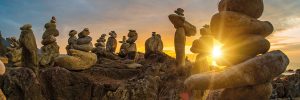
Take a stone, small enough to hold in your hand.
Sit with it quietly. Stones appear across Guatemala —in the ruins of Maya cities, in rivers that carried refugees, in the earth that holds unmarked graves.
They symbolise both burden and endurance. Hold the stone and name—silently or aloud—a truth you need to honour.
It may be a truth from your own life, from your community, or from the wider world.
Place the stone in a bowl of water.
Let it settle.
Watch how the water receives it without resistance.
journalling prompt
“Truth rising like dawn”
Imagine the slow brightening of a Guatemalan morning: light brushing the mountains, mist lifting from Lake Atitlán, colours appearing in woven textiles.
Use that image as a frame for reflection.
Write or sketch:
• Where in my life is truth emerging slowly, gently- like dawn?
• What would healing look like if truth were treated not as accusation but as light?
You may want to draw a horizon line and let colours of dawn expand across the page as you write.