Week III • Thursday
Canada
Week III • Thursday
Voices from the Landscape
The Land Remembers
Across the northern plains and deep forests of Canada, the land is full of memory. The prairies hold the tracks of bison herds long gone. Lakes mirror skies that once guided Cree, Dene, and Anishinaabe hunters home. Cedar and spruce stand where generations prayed, fished, gathered medicine, and learned the stories that root a people in place.
But these landscapes also carry wounds.
“Sometimes the land cries with us,” an Elder says.
“It remembers the children.”
Many First Nations communities live with the ongoing weight of the residential school system — children taken from their families; languages forbidden; ceremonies outlawed; names replaced with numbers. The trauma, carried across generations, still rises like cold fog off the water. As unmarked graves continue to be found, the land itself seems to exhale long-held sorrow. Yet the story is not only grief. It is also resilience.
Across the country, languages once nearly silenced are returning to the lips of children. Drums beat again in community halls. Elders teach young people how to harvest medicines, prepare fish, and listen to the land. Healing circles rise where silence once lived.
Still, the challenges remain real. Many communities face unsafe drinking water, limited healthcare access, and housing shortages that have lasted generations. Young people wrestle with high suicide rates, the legacy of colonisation, and the pressure of living between worlds. Climate change threatens hunting grounds and traditional food sources, while industry often enters Indigenous territory without consent.
“People say we are broken,” the Elder murmurs, running a hand along the bark of an old cedar. “But we are not broken. We are burdened — and still standing.”
Healing is found in many forms: truth-telling gatherings, land-back movements, language immersion schools, renewed relationships, and ceremonies once outlawed. It is found when communities restore power over their own futures and when the land itself is honoured and protected.
And it is found, always, in relationship — with Creator, with ancestors, with one another, and with the earth that has carried every footstep.
“When we hurt, it hurts. When we heal, it heals. We rise together.”
The land remembers — but it also waits, patient and strong, for healing to come.
wonderings
- I wonder what it means to believe that the land itself remembers – not only beauty, but wounds.
- I wonder how reconciliation changes when it is understood as the restoring of relationships, not the erasing of history.
- I wonder where I am being invited to listen more deeply – to land, to community, to stories that carry pain and strength.
- I wonder how healing becomes possible when a people begin to reclaim what was once taken: language, ceremony, land, dignity.
Reflection
In Indigenous theology across the Canadian prairies and forests, the land is not scenery but kin. Cree theologian Ray Aldred writes that land is “the place where the Spirit speaks,” where Creator’s presence is woven into rock, river, and root. In this worldview, healing cannot be separated from land, community, or memory. When the Elder says, “The land cries with us,” this is sacred truth: the land shares our wounds because it shares our life.
The trauma of the residential schools was therefore not only an assault on children and families – it was an assault on the sacred relationships that hold a people in balance. The land witnessed the taking of names, languages, and ceremonies. It still holds that sorrow. Yet the land also carries the seeds of renewal.
Cree scholar Willie Ermine speaks of “ethical space”: the spiritual ground where Indigenous and non-Indigenous peoples can meet in honesty, humility, and truth. In this space, reconciliation cannot be reduced to apology or sentiment. It must restore relationships – between peoples, with Creator, and with the land itself.
For Indigenous theologians, repentance means returning to right relationship. Justice means restoring what was taken: clean water, respected land rights, language schools, safe homes, and self-determination. Healing emerges when ceremonies once outlawed return to the centre of community life, and when children speak the languages their great-grandparents were punished for knowing.
As Anishinaabe teacher Geraldine McAlpine writes, “Healing begins when the stories come home.” When Elders teach harvesting medicines, when drums sound again, when young people learn that they are not broken but burdened – these are acts of resurrection.
In this theological landscape, reconciliation is not political achievement but spiritual restoration: a circle repaired, a relationship renewed, a people rising together with the land that has always held them.
prayer
Tânisi Kîsikâw Paskwâwimostosakêwin,
Kîsikâw Misi-Manitow,
kîhtwâm ka-wîcihitoyahk.
Mâmawi ka-miyo-ohpikihitowak,
ka-miyo-wîcêhitoyahk,
ka-miyo-ohpikihikoyahk askîhkwahk.
Pimihtâtân miyo-wîcêhitowin,
miyo-ohpikihitoyahk.
Translated from Cree:
Today we greet this sacred day and season.
We give thanks to the Great Spirit,
who walks with us still.
Together we are held in care;
together we live in right relationship;
together we are nourished upon the Earth.
We journey onward in good relations,
sustained by love, upheld by care.
bible reading
John 6:1–15 :
Feeding the 5,000: Bread for the Hungry World
The story of the feeding of the five thousand is one of the most familiar narrative sin the Gospels. Yet beneath its abundance lies a radical vision of what true reconciliation means. The people who follow Jesus to the hillside are hungry, not only for food but for hope. They come with empty hands and uncertain faith. Jesus does not turn them away; he takes what is small and available, blesses it, and multiplies it until all are fed. In this simple act, the divine economy of grace and love confronts the human economy of scarcity.
Gustavo Gutiérrez, the Peruvian Dominican and father of liberation theology, helps us to see that this is not just a miracle of bread, but a sign of conversion . It is the transformation of hearts and structures so that the hungry may be fed. In his book We Drink from Our Own Wells, Gutiérrez writes that authentic spirituality is born not in comfort but in solidarity with the poor. Penance, he insists, is not a private sorrow for personal sin but the turning of privileged hearts toward the suffering of others. It is a movement from isolation to communion, from self-protection to shared humanity.
At the hillside that day, one young lad offers his lunch : loaves and fishes . A small and insufficient amount for the task of feeding so many, yet it freely is given. His act is penance in its truest form: a surrender of what he holds so that others may live. In the hands of Christ, his gift becomes abundant food for all. The miracle begins not with divine intervention but with human compassion.
In many ways this passage speaks directly to the crises of our world .Its hunger, inequality, and exclusion. Jesus does not spiritualise the people’s need; he meets it with bread. The Incarnate Word is not indifferent to the needs of people . Gutiérrez teaches that the gospel calls us to a “preferential option for the poor” . This is not as ideology but the concrete practice of love. Faith without solidarity with others especially the poor remains incomplete.
Here, penance is a turning outward . It’s the recognition that our abundance is meant for sharing, that conversion must be visible in acts of justice. Lent becomes not a retreat into guilt, but a reorientation of life toward generosity. True penance is the refusal to accept a world where some feast while others starve.
The Peace, in this passage, is the peace of community restored and hope filled. ccrowd once fragmented by hunger now united by shared food. In blessing and breaking bread, Jesus creates not just a meal but a fellowship of hope..and a sense of belonging. . Peace is not quietness but justice lived out in relationship with others . It is what happens when love reorders the world’s priorities.
Reconciliation follows as social transformation. The miracle points toward the Eucharist, where divine grace and love is given in broken bread and a shared cup – and not to a few but to all. The table of Christ is a protest against exclusion, a sign of God’s dream that every person may eat and live. Gutiérrez calls this “a spirituality of liberation”: to drink from our own wells of faith until they overflow into compassion, to discover God’s presence in the struggle for dignity and daily bread.

reflective action
If possible, step outside for a few minutes today.
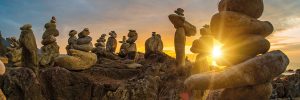
Place your hand on the earth, a tree, or a stone.
Feel its steadiness, its patience, its memory. Pray silently:
“Teach me to listen to the land. Teach me to walk gently. Teach me to restore what has been harmed.”
Let one small action flow from this prayer – a word of kindness, a step toward justice, or a commitment to honour the place where you live.
journalling prompt
Think of a landscape, memory, or community that has shaped you.
What stories does it hold — spoken or unspoken?
What wounds does it carry, and what signs of healing do you see?
Where might Creator be inviting you to restore a relationship: with land, with history, with yourself, or with another?
Write or draw gently and honestly, allowing the stories to rise without forcing resolution.