Week V • Thursday
Tonga and Melanesia
Week V • Thursday
Voices from the Landscape
In the islands of Tonga and Melanesia, love and risk are often carried on the wind—through the salt-sweet scent of the sea, the tang of coral reefs, the perfume of frangipani offered to a guest. Archbishop Winston Halapua, writing from the Pacific’s vast expanse, describes the ocean as “the body of God’s embrace”—an ever-moving revelation of relationship, rhythm, and renewal.
In Waves of God’s Embrace, Halapua speaks of moana theology—a theology born not of empire or certainty, but of fluidity and trust. The sea’s currents, he says, teach us to live in between: between storm and calm, life and death, giving and receiving. The fragrance of Christ’s love, like the scent that fills Mary’s house, flows outward—not to enclose but to connect.
For the peoples of Oceania, the va—the sacred relational space—is the ocean between islands, the breath between friends, the silence between words. It is in this va that reconciliation and love are made real. The perfume poured out at Bethany, like the oil of hospitality offered to a voyager, restores balance to the va. Its fragrance heals what distance has divided.
Halapua invites us to see the ocean not as a boundary but as God’s pulse—the place where risk and love meet. “We are waves in God’s tide,” he writes, “called to move, to break, to flow, and to embrace.”
wonderings
- Where is the va, the space of relationship, wounded in my life or community
- What would it mean for me to pour out something costly in love
- How might we become keepers of the va, tending landscapes of peace and reconciliation in our world?
Reflection
When Mary breaks open her jar of perfume, the room fills with fragrance—a scent that lingers long after the act itself. It is the smell of costly love, the aroma of risk. The ocean knows this scent. Stand on the Tongan shore at dawn: the air is thick with salt and wind, carrying traces of coral and seaweed, promise and decay. Love here is never safe. Every voyage begins in trust, every return is uncertain.
So too, Mary’s gesture is a voyage—an act of surrender into the unknown tide of God’s will. She anoints Jesus not for triumph, but for burial. Yet in that act of letting go, she becomes a pArcticipant in divine renewal. Like Francis embracing the leper, she crosses the line between fear and compassion. What was once bitter becomes sweetness; what was repulsive becomes beautiful.
In Melanesian communities, when reconciliation is sought, people gather near the sea. They wash their hands together in saltwater, and the smell of the ocean becomes the sign of restored relationship. The bitterness of offence dissolves into the deeper tide of grace.
Mary’s perfume and the ocean’s salt share one truth: love’s fragrance cannot be contained. It spreads, seeps into wounds, softens what was hardened. It carries the risk of misunderstanding and the promise of transformation. The Gospel calls us into that same current—to risk proximity, to anoint the wounded Body of Christ in our world, and to let the scent of God’s embrace carry across every tide and shore.
prayer
God whose love moves
like tide and wind,
breathe your fragrance into our lives.
Where the va between us
has been stretched or wounded,
let your Spirit flow like saltwater,
cleansing, softening, restoring.
Teach us the courage of Mary,
who broke open what was precious
so that healing could fill the room.
Teach us the wisdom of the ocean peoples,
who know that love requires risk,
and reconciliation begins with stepping into the tide together.
bible reading
John 12:1–11:
Mary anoints Jesus : Healing the Va
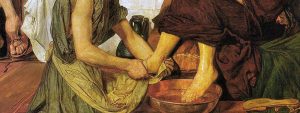
Bethany is a household alive with memory and meaning—a landscape of friendship and grief, of gratitude and impending loss. Around the table sit those who have known both death and life: Lazarus, once bound in burial cloths; Martha, who served through sorrow; and Mary, whose hands now pour perfume over Jesus’ feet.
Into this fragile scene we are invited to see not only an act of devotion but the healing of the va—the sacred relational space between people, God, and creation. In Polynesian thought, va is the invisible yet essential fabric of life: the field in which harmony, respect, and love are sustained. When that va is damaged through violence, neglect, or injustice, tauhi va—the tending and restoration of relationship—becomes a sacred calling.
Mercy Ah Siu-Maliko speaks of a theology that begins where relationships are wounded: in families, in communities, and in the Church. Mary’s act can be seen as precisely this kind of embodied theology. She steps into a tense room, heavy with grief and accusation, and without speaking she moves toward Jesus with tenderness. Her gesture bridges the space between life and death, fear and love. Her touch, her tears, and her perfume become sacraments of healing.
For Ah Siu-Maliko, reconciliation is not abstract confession but embodied repair. It happens when love dares to cross boundaries of shame and status, when silence is filled with mercy’s fragrance. Lent, then, becomes a time to ask: where has the va been wounded—in our relationships, our communities, our Church? And how might we, like Mary, bend low to restore it?
Mary’s act also carries ecological and economic resonance. The pure nard she uses comes from the earth—costly, fragrant, harvested through labour and long trade routes. It reminds us that love, if it is real, always costs something. All creation is bound together and held in God’s world. In Bethany, the whole house is filled with the scent of healing. This points to reconciliation not only between people but also between humanity and the more-than-human world.
Judas’s protest about waste reveals the tension between calculation and the generosity of grace. Mary’s outpouring defies logic; it flows from relational abundance rather than economic scarcity. In this, we glimpse what Francis of Assisi lived: a poverty of spirit that frees a person to give without counting the cost. This is the restoration of balance, the healing of the distorted va between people, God, and the earth.
Rev Dr Tevita Havea teaches that to tauhi va—to keep and tend the relational space—is the essence of peace. It is done through small acts of care, hospitality, and humility. In Bethany, Martha serves, Mary anoints, and Lazarus sits at table. Each tends the va in their own way, and Jesus receives their love as preparation for his Passion.
Yet the keeping of the va is never tidy. It happens in the midst of misunderstanding and cynicism. Judas’s suspicion hovers over Mary’s devotion, unable to see the deeper truth. And yet grace works within the brokenness, quietly stitching together what has been torn.
For our Lenten journey toward Francis 800, tauhi va becomes a call to communities and nations: to mend what has been damaged by colonisation, greed, or neglect; to tend the spaces of trust between human and more-than-human creation; and to live peace not as avoidance of conflict but as the faithful restoring of relationship.
Through an Oceanian lens, Lent is not a solitary desert but an oceanic landscape—a wide field of relationships needing healing.
Penance is the courage to name where the va has been harmed. Peace is the slow, daily work of keeping that space with care. Reconciliation is the fragrance that fills the whole house when love is poured out freely.
Mary’s act at Bethany becomes our map: Penance—recognising what is fragile and precious.Peace—moving gently into the wounded space. Reconciliation—letting love transform the atmosphere for all.
Her story calls us to let our Lent become an anointing: a season of healing gestures, restored relationships, and communities learning again how to tauhi va. In doing so, we mirror the Spirit of Francis, who kissed the leper and called every creature brother and sister.
reflective action
If possible, go outside and find a place where you can breathe in the air—near water, a garden, or even by opening a window. Breathe slowly and deeply three times, remembering that each breath carries the scent of God’s creation. As you breathe, pray silently:“May my life carry the fragrance of your love.”
If there is a relationship in your life that feels strained, send a message, write a note, or make a small act of kindness—a drop of perfume upon the wounded va.
journalling prompt
As you imagine the scent of the sea or of Mary’s perfume filling the room, what memories or emotions does that fragrance awaken in you?
Where in your own life might love be calling you to take a risk—to pour yourself out, to cross a boundary of fear or resentment, to heal a broken va (relationship space)?
Record a time when what once felt bitter began to reveal its sweetness.