Opening Prayer
(5 minutes)
Read slowly:
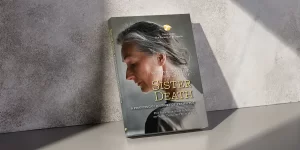
St. Francis spent the last few days before his death praising the Lord and teaching his companions, whom he loved so much, to praise Christ with him. As much as he was able, he broke out with the Psalm: “With my voice I cry to the Lord.” He likewise invited all creatures to praise God and, with the words he had composed earlier, exhorted them to love God. Even death itself, considered by all to be so terrible and hateful, he exhorted to give praise. Going joyfully to meet it, he invited it to dwell with him. “Welcome,” he said, “my Sister Death.”
Thomas of Celano’s Second Life of St. Francis
Sit quietly for a minute.
Personal Reflection
Take a few moments to consider:
- How do you imagine yourself dying as a Franciscan?
- What would be similar to or different from the death you might imagine for any faithful Christian?
Write whatever comes to mind.
Do not edit; just notice.
Introduction:
Francis and Lady Poverty
(10 minutes)
There is an ancient idea given more recent expression by the Franciscan Richard Rohr: “The way you live is the way you die.”
Living in selfishness and a sense of entitlement can lead to dying in bitterness and fear. When we’ve spent our life pursuing our own goals, fully invested in our own dreams, we can only expect frustration and disappointment if we don’t achieve them. In time, frustration and disappointment can turn to bitterness and resentment. Life is unfair, others got the acclaim when we worked just as hard, we sacrificed everything, and no one appreciates us.
The 1984 film Amadeus tells the story of the composers Wolfgang Mozart and Antonio Salieri. While not strictly true to the history, the film paints a powerful picture of Salieri’s resentment of Mozart’s effortless genius, and the shadow it casts over Salieri’s own more modest talent. Even the best work he can crank out with sweat and tears is easily eclipsed by Mozart’s musical throwaway lines. And it consumes him. Salieri had prayed to glorify God through his music. Mozart is childish, crude, and irreverent–and yet he shines. It feels like a betrayal by the very God Salieri had longed to serve, and his spiritual crisis deepens.
Salieri is a picture of a man living with a sense of entitlement. His hands are closed tightly around what he believes he deserves, and it runs through his clenched fists like water. Without the humility to accept God’s choice to give or withhold, he will never be free but will die on the altar of his own grievance.
For most of us, our inability to trust God and release our own hopes and plans will not be this glaring. But they lead to the same place: an inability to live in the freedom and joy God has for us. And as our time grows shorter and the losses mount, the cumulative effects of our choices solidify. Like a pony circling a post, our steps create, first a path, then a rut, then a ditch from which we can’t climb out.
It’s a gloomy picture! But the good news is that there is always more than enough grace to change it, if we’re open to the Spirit’s work within us. And this is where we can look to St Francis for inspiration. Francis cherished Lady Poverty because he understood poverty to be the gift that pries our grip off the entitlements and distractions that erode our freedom, and steal our joy.
Francis’ bond to Lady Poverty was no quick fling but a long-term, fully committed relationship, because he understood that the way we live is the way we die. So he lived sine proprio, or with nothing of his own. He knew that if he claimed nothing as his own, then life could take nothing away from him. He could lose everything, and still be left with perfect joy.
And when Sister Death came for him, he could welcome her because he had spent a lifetime welcoming Lady Poverty. Did he see them, at the end, as one and the same?
Death is the ultimate poverty, the final surrender to the limits of the human condition. For Francis, surrender had been his way of life, so death was not an interruption but a continuation.
The person who has spent years relinquishing wealth, status, certainty, control, and self-will has already been rehearsing for death. This is the Franciscan way. Sister Death is simply the last act of kenosis.
Wondering
- What are the things I find most difficult to relinquish—control, certainty, reputation, competence, possessions, independence, health?
- What might God be teaching me through those struggles?
- How might my daily practice of letting go, forgiving, accepting limitations, or embracing vulnerability be preparing me for that final surrender?
- Where do I sense resistance to that process?
Reflections
Reflective Action
(15 minutes)
Franciscans live with a Rule of Life, which gives structure to our lives and continually brings us back to what matters most.
What would it look like to have a Rule of Death? What would your goals for such a guide be, and what practices would continually draw you closer to them?
Reflect quietly for a moment.
Then try sketching out a preliminary Rule of Death. How would it differ from your current Rule of Life? What continuity between the two would there be?
Closing Prayer
Lord Jesus Christ,
You who emptied yourself and entrusted your spirit
into the Father’s hands, teach us the way of holy surrender.
Like Francis, help us to release all that cannot save us
—our possessions, our achievements, our need for control—
and to rest more fully in your grace.
When suffering comes, may prayer be our native language.
When fear arises, may we remember your Passion.
When we face our limitations,
may we discover again our dependence upon you.
Grant that we may live in such a way
that when Sister Death comes,
she may find us trusting in your mercy, resting in your love,
and ready to enter the joy you have prepared for us.
May our living and our dying give glory to God.
In your most holy Name,
Amen.
Final wondering
- At the end of my life, what do I hope will be left when everything else has been taken away?